
Martin County Court Records After Arrest
After a person is arrested in Martin County, the record path splits. Jail custody runs through Bertie-Martin Regional Jail in Windsor. The court case runs through North Carolina Judicial Branch systems for Martin County. The arrest and booking paperwork may describe initial allegations, but the filed court record is the case that moves through first appearance, bond, prosecutor review, hearings, plea, trial, dismissal, or judgment.
The Martin County Governmental Center is the local court location at 305 East Main Street in Williamston. The NC Judicial Branch contact directory lists the main court and Clerk of Superior Court phone as 252-809-5100, Magistrates as 252-809-5119, and District Attorney contact as 252-940-4010. Court hours are Monday-Friday, 8 AM-5 PM. For custody and booking details, use Martin County jail inmate records; for booking-photo questions, use Martin County jail mugshots.
Find Martin County Court Records
North Carolina eCourts is the main online route for case information, hearing dates, and court records. The Judicial Branch also describes public self-service terminals at clerk offices. Those terminals can search criminal case information by defendant name, case number, or victim and witness name. Paper files are accessed in the county where the case is located, so Martin County paper criminal files route through the Clerk of Superior Court in Williamston.
- Start with the NC eCourts Portal for case information, hearings, and payment functions.
- Search by defendant name, case number, citation number, party name, attorney name, or hearing fields when available.
- Use Martin County as the county filter when the portal or search tool offers one.
- Open the case and compare each charge, status, hearing, and disposition with any jail custody information.
- For paper records, certified copies, or terminal searches, contact the Clerk of Superior Court at 252-809-5100.
The NC Judicial Branch portal training page documents search and payment features, including hearing searches by case number, party name, business name, attorney name, attorney bar number, judicial officer, and courtroom.
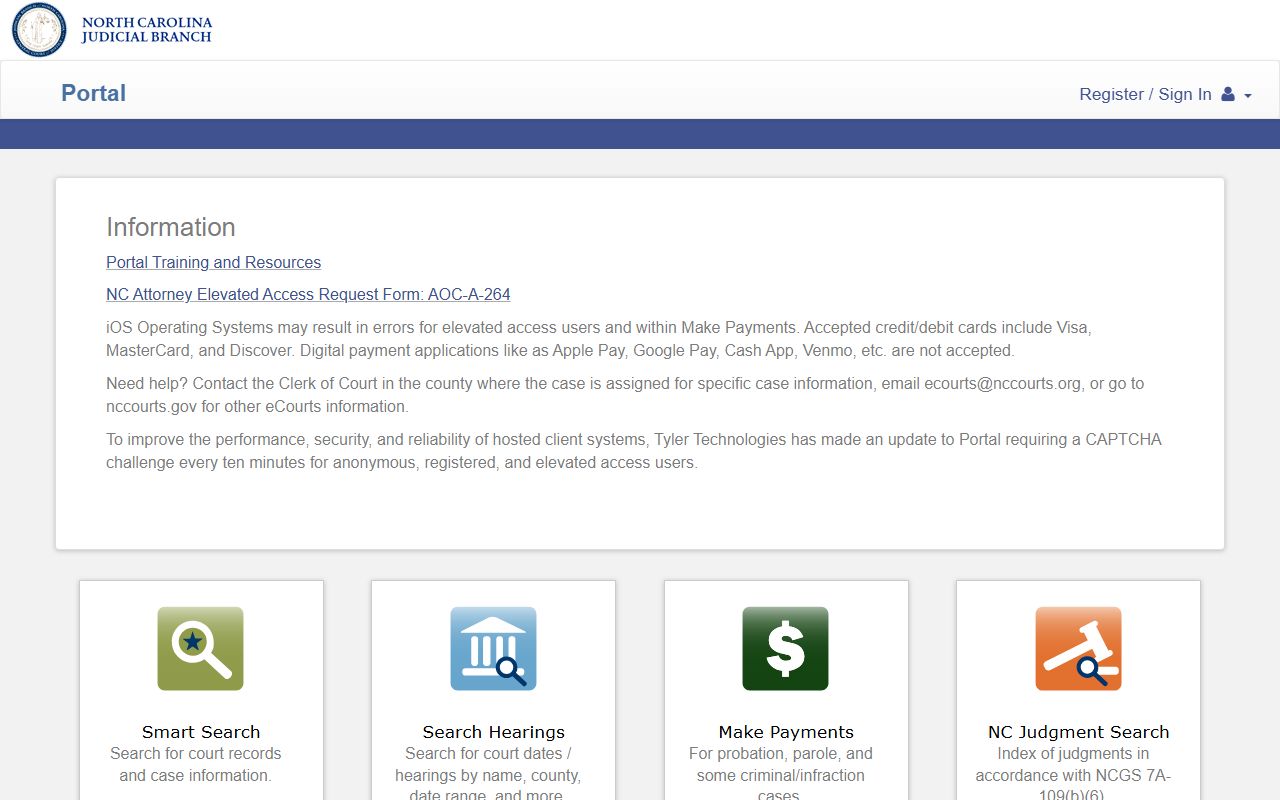
The portal screenshot shows why court records after a jail arrest should be treated as case records, not as a jail roster. Court search fields follow the case, while the jail phone and app channels follow custody.
Martin County Court Search Fields
The court portal and clerk terminal do not work like a mugshot or jail roster search. A name search may return more than one person or case. A case number or citation number is more precise when known. If a case is newly filed, a recent arrest may appear first as a hearing or calendar entry before every document is available to the public.
| Field Label | Type | Required | Notes |
|---|---|---|---|
| Smart or case search | Web search | Unspecified | Portal searches case information by name, case number, attorney, citation, and more. |
| Case number | Text | No | Best when available from paperwork, bond papers, or court notice. |
| Party or defendant name | Text | No | Useful for criminal cases, but similar names must be checked carefully. |
| Citation number | Text | No | Helpful for traffic and citation-based criminal matters. |
| Attorney name or bar number | Text | No | Useful when a lawyer has appeared in the case. |
| County | Filter | No | Use Martin County to narrow local cases. |
| Judicial officer or courtroom | Text or dropdown | No | Used for hearing and calendar searches when available. |
Martin County Charging Records
Arrest charges are not always the final charges filed in court. The District Attorney represents the State of North Carolina in criminal cases and assigns prosecutors for Martin County matters in Prosecutorial District 2. The district page names Tom Anglim as District Attorney for the district that includes Martin County. The DA cannot give legal advice to defendants, but the office is part of the court path once charges are prosecuted.
| Document | Who Uses It | What It Does |
|---|---|---|
| Complaint or criminal process | Officer, magistrate, or prosecutor path | States the alleged offense and can begin the court case after arrest. |
| Information | Prosecutor | Formal charging document used in some criminal proceedings. |
| Indictment | Grand jury | Formal felony charging document after grand jury action. |
A charge can be amended, reduced, dismissed, or replaced as the case moves. That is why a booking description should be checked against the court record. The court record is the source for filed charges and dispositions, while the jail record is the source for custody and release status.
Martin County Court Charge Status
Court records after a jail arrest often contain status terms that are easy to misread. A pending charge is an accusation still moving through court. A dismissal ends the charge without a conviction. A disposed case has an outcome, which may be a plea, judgment, dismissal, or other final action. A court date is only a scheduled appearance.
| Status | Meaning | Record Caution |
|---|---|---|
| Pending | The charge or case remains open. | No conviction should be inferred from pending status. |
| Amended or reduced | The prosecutor or court changed the charge. | Compare current charge text with the original arrest allegation. |
| Dismissed | The charge ended without conviction. | A dismissal may still appear in some records unless later expunged. |
| Nolle prosequi | The State does not proceed on that charge. | Often treated as a prosecutor dismissal, subject to record context. |
| Disposed | The case has an outcome. | Read the disposition before treating it as a conviction. |
Martin County Bond Records
Bond is a release condition, not a final result. For immediate custody, call Bertie-Martin Regional Jail at 252-794-9283. For release conditions set by a judicial official, the Martin County Magistrate can be reached at 252-809-5119. Clerk records may show case and payment status after filing. Local sources did not publish a complete bond schedule, accepted payment methods, kiosk rules, or after-hours posting rules.
| Bond Type | How It Works | Martin County Step |
|---|---|---|
| Written promise or recognizance | Release based on a promise to appear. | Confirm court date and conditions with the court record. |
| Unsecured bond | No money is posted up front, but payment may be owed after violation. | Verify paperwork and court obligations. |
| Secured or cash bond | Money, property, or surety is required before release. | Call the jail or magistrate before traveling with payment. |
| Surety bond | A licensed bondsman posts bond under a contract. | Use authorized bondsman channels and read terms closely. |
| No-bond hold | Release is not available until court or another agency clears the hold. | Ask whether probation, parole, federal, immigration, or other-county holds exist. |
Martin County Warrant Records
No official Martin County sheriff active-warrant web search or most-wanted list was located in county sources. Warrant questions are best handled through the agency or court office tied to the warrant. For nonemergency sheriff warrant questions, call 252-789-4500 during office hours. For court-issued process, contact the Clerk of Superior Court or Magistrates. If the warrant leads to an arrest, local custody moves to Bertie-Martin Regional Jail.
Common warrant terms include arrest warrant, bench warrant or order for arrest, fugitive warrant, probation or parole violation warrant, and search warrant. A search warrant is not a custody record. A fugitive or supervision hold may keep a person in jail even after a local bond is posted. A person who believes a warrant exists should contact legal counsel or the issuing office for instructions before appearing without a plan.
Martin County Charge Records
A charge means the State has accused a person of an offense. A conviction means guilt was adjudicated by plea, verdict, or other final judgment. Court records after a jail arrest can show both, but they should not be treated as the same. A dismissed charge, pending charge, or amended charge should be read in context before making any conclusion.
| Question | Charge | Conviction |
|---|---|---|
| Stage | Accusation after arrest or prosecutor filing. | Final guilt finding or accepted plea. |
| Proof level | Based on probable cause or charging decision. | Based on plea or proof beyond a reasonable doubt. |
| Record effect | Can appear even if later dismissed. | Can affect sentencing, rights, and background checks. |
Important: Do not use public record search results for employment, housing, credit, insurance, or another FCRA-covered decision.
Martin County Expunged Court Records
North Carolina expunction law is separate from routine court search. Expunction is the process for removing eligible criminal records from public access. Sealing limits public visibility, while expunction can remove eligible records under court order. Eligibility depends on the charge, disposition, waiting period, prior record, and statute. The jail cannot expunge a court record.
| Issue | Sealed | Expunged |
|---|---|---|
| Public access | Hidden or restricted from ordinary public view. | Removed from public access if the order applies. |
| Who handles it | Court process or court order. | Court process under North Carolina expunction statutes. |
| Effect on jail data | May require separate custodian review. | Provide the order to agencies that still show affected records. |
Martin County Background Checks
The NC Judicial Branch criminal background check page describes a certified single-county criminal record search through the clerk for $25 using form AOC-CR-314. For mail requests, the Judicial Branch says money order or certified check is used. In person, credit card, cash, money order, or certified check are accepted. That certified clerk search is not the same as a live jail custody check.
For a statewide personal review, the SBI Right to Review process uses fingerprints and a $14 fee to search the North Carolina computerized criminal history file, with a formal response by U.S. Mail. These checks serve different needs than a quick court portal search. They also do not authorize use of non-FCRA public pages for FCRA-covered screening decisions.